Kittenflies™ ExplorePrinciples of DesignScale and Proportion
Principles of Design: Scale and Proportion
Big, small and just right!
Scale and proportion
Scale and proportion are both design principles that have to do with size. Scale is the size of one object in relation to the other objects in a design or artwork. Proportion refers to the size of the parts of an object in relationship to other parts of the same object. Throughout the centuries, designers have used scale and proportion to depict or distract from the ideal. As with principles such as unity and balance, artists use scale and proportion to convey their unique insights to the viewer.
Try it
Scale
Scale
Humans judge the scale of something according to body size. Some of the most common adjectives that apply to scale include:
Try it
When an artist or designer chooses to make particular objects oversized or miniature, it is often to emphasize their importance or encourage a new perspective.
Scale
In the above public artwork, the person pushing the sphere provides a sense of scale. Given the reflections of skyscrapers in the sphere, viewers might infer that the globe symbolizes the world, and its relatively small scale suggests that humans can manipulate it.
Try it
Scale
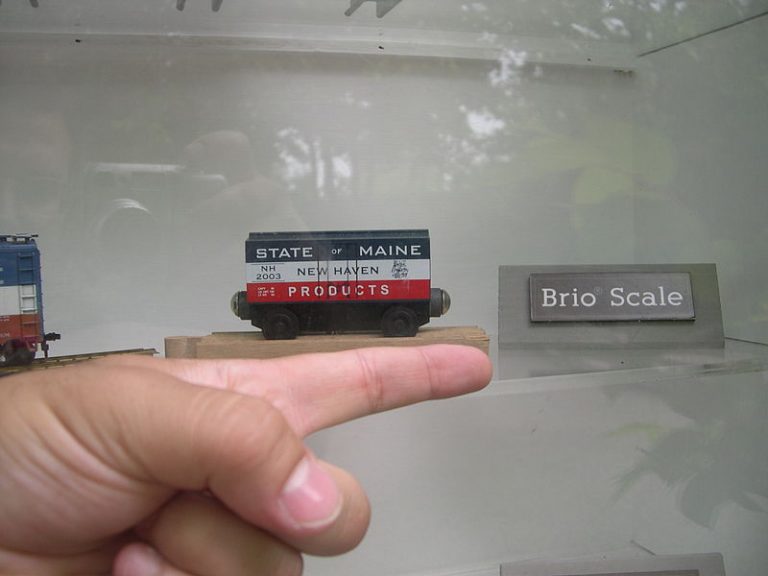
Some toys are miniatures of actual objects. For example, scale model cars, trains and dollhouse furnishings replicate real objects on a smaller scale. In the photo below, the man’s hand gives you a good idea of the actual size of the toy rail car. Scale model toys give children the power to manipulate realistic objects that are otherwise too big for them to manage.
Try it
Proportion
Proportion
Proportion is a principle of design that pertains to the relative size of the components that compose an object. Again, the human body is the standard by which people judge proportion. An eye should be smaller than a face, for instance, and a male’s shoulders should be wider than his hips.
Try it
Proportion
The golden ratio is a mathematical method for determining proportion. It is about 1.618 to 1, a number called phi. Artists and designers have used it for centuries, and some people believe the ancient Egyptians used it in designing the pyramids, though historians aren’t sure. Some people also believe that proportions close to this ratio look especially pleasing.
Try it
Disproportion
When you see a disproportionate object, it catches your attention. Cartoons with large-headed people, for example, catch your eye. Obvious exaggeration may even tickle your funny bone. “The Head” by Eric Fogel is a good example:
Try it
Disproportion
In Greek mythology, monstrous characters like Medusa had disproportionate traits that set them apart from humans. Instead of hair, Medusa had poisonous snakes growing from her head, as the artist Caravaggio shows below.
Try it
Hybrid and Fantastical Figures
Artists can also experiment with proportion by combining features from different creatures, such as giving Medusa snakes for hair or adding butterfly wings to a kitten. The size of these features in relation to the rest of the figure can help create different effects, making a character seem funny, magical, or frightening.
Try it
Proportion
In contrast, an artwork in which all of the figures are proportionate can make you feel calm and content. Rather than challenging your emotions, proportion infuses you with a sense of completeness. Georges Seurat’s “A Sunday on La Grande Jatte” shows stylized people, all well-proportioned and on the same scale, relaxing on a sunny afternoon. Even though there are variations of light and lots of activities to look at, the overall effect is serene.
Activity
Today’s Activity: Make a Scale Drawing
Supplies:
Plain, 8 x 10 paper
A picture of your favorite cartoon character that is at least 10 inches tall
Ruler
Pencil
Scissors
Markers, paints or colored pencils
Lightly draw a grid with pencil over your cartoon print. Mark 1-inch lines all along the perimeter of the page, and then connect them across the page to make a grid of 1-inch squares.
Number the squares on your print, starting at the top left and proceeding from left to right from the top row to the bottom row.
Draw a grid on your plain paper. Mark 1/2-inch intervals along all four sides, and then connect the marks to make a grid of 1/2-inch squares. Your scale drawing will be 1:2, or half the size of the original.
Activity
Number the squares on your plain grid the same, duplicating the number of squares and rows of the original. Cut off the extra squares and set aside.
Copy the design onto your blank grid, going square by square. Try to match the straight lines and curves within each square on the original to make your smaller scale drawing as similar as you can.
Use markers, paints or colored pencils to color in your scale drawing like the original.
Try it
Activity
Use your extra grid to experiment with proportion. For example, make one eye of your cartoon figure twice as large as the other. Make one hand tiny and the other large. What effects do your changes have?
Try it
Big, small and just right: you’ve got it!
Real-life art
Taking It Offline
These activities live on the screen, but art loves real paper, paint, and glue too. Here are things we made by hand, plus ideas to try at home.
A scale drawing on paper
Draw a grid of 1-inch squares over a cartoon picture and a grid of 1/2-inch squares on plain paper. Copy it square by square to make it half the size!