In math, a line is always solid and straight and a line always goes on and on in both directions. Artistic lines are different — they can be straight, bent, dashed, and have a cool paint brush texture to them. They don’t have to go on and on forever either!
Try it
Line
In this example, artistic lines are used to create a sunburst.
Try it
Line
Artistic lines have a TYPE, like straight, curved, or angular. They have a DIRECTION in relation to the surface, like a piece of paper, or a canvas. Direction can be horizontal, vertical, or diagonal. Line QUALITY can be called thick, delicate, bold, thin, and so on.
Line
In art, line is a primary design element that is by nature two-dimensional but can suggest three-dimensional forms. For example, the line drawings in French master Matisse’s Thème et Variations series feature spare, unshaded lines that create feminine and still life figures. Matisse also worked in printmaking, producing woodcuts, lithographs, intaglios and linoleum cuts, which all involve the primary use of line.
Line
A line is a static mark on a page but it contains momentum. It affects a viewer on a subconscious level with its direction, weight and variations. A line drawing of a pointing finger directs the eye in a particular direction.
Try it
Line
The lines in a painting draw the eye toward a vanishing point:
Try it
Just as important as the other features of design – form, shape, space, color, and texture – line has the ability to incorporate all of these elements in a simple series of pen strokes.
Line in crafts
Calligraphers use straight and curved lines to create formal or casual tones, produce decorative or utilitarian effects, and communicate energy or stasis. For example, script alphabets such as Copperplate denote momentum with forward-slanting letters and decorative formality by virtue of curved ascenders and descenders. Upright lettering styles such as Bookhand denote formality and a reserved flair with moderate curves and serifs, or tails, finishing off the pen strokes.
Try it
Copperplate
Kid Courses
Copperplate script was prevalent in the 19th century, but was used as early as the 16th century in Europe.
Bookhand:
Kid Courses
Modern Calligraphy:
Kid Courses
Line in crafts
In quilting, the simplest use of line is the stitching that secures the top, back, and batting layers of the quilt in a single package. Whether applied by hand or machine, quilting can consist of simple rows of vertical or horizontal stitching lines, crossing diagonal lines, continuous line patterns such as feathers or waves, or meandering lines known as stippling. Lines of stitching are decorative and functional.
Line in film
The Visual Story: Creating the Visual Structure of Film, TV and Digital Media by Bruce Block is one of our favorite books ever. The image below shows a storyboard where 11, 12, and 13 would be the most intense scenes. As you watch films, try to notice how the motif (horizontal verses diagonal) mirrors the intensity of the storyline.
Horizontal motif (calm):
Diagonal Motif (intense):
Motion warningThe intense scenes shake and move fast. If moving pictures bother your eyes or make you feel dizzy, skip this one.
Line in crafts
The use of line is essential in virtually all forms of crafts, including basketry, calligraphy and quilting. From the spiraling lines of the weave to the geometric designs of the Tlingit, or the boldly striped patterns of the Haida, the baskets crafted by the Northwest Coast Native Americans utilize line to lead the eye around the basket’s curves. The bold designs of each basket emphasize its cultural importance. It is a vessel historically designed to contain sustenance and to bear the gifts that maintain intertribal bonds. In addition to baskets, the Native Americans also created beautiful hats.
Before you make your basket
Meet the Tlingit basket
The Tlingit (say it: KLINK-it) people have lived for a very long time in southeastern Alaska and nearby parts of Canada. Tlingit weavers are famous for their beautiful baskets.
Weavers twist and weave the baskets from young spruce tree roots, gathered in spring or fall.
They add patterns by wrapping dyed grass or fern stems around the outside of the weave. This is called false embroidery.
The patterns are made of lines and shapes, and they have names like “leaves of fireweed,” “shaman’s hat,” and “half the head of a salmonberry.”
Many baskets were round with flat bottoms, made for picking and storing berries.
Tlingit weavers still make baskets today.
Your coffee-container basket uses lines the same way: bands of pattern that lead your eye around the curve.
Today’s art idea for kids:
Today’s art project for kids: Make a Tlingit basket by upcycling a plastic coffee container!
Upcycling means turning something you would throw away into something new and useful. Your empty container becomes a basket covered in bands of line patterns.
What you need
An empty, clean container: a plastic coffee container, a coffee can, or a round oatmeal box
Your basket band strips (you will design and print them on the next slide)
Scissors
Tape or a glue stick
Markers or crayons, if you want to add more lines by hand
Using a metal coffee can? Ask a grown-up to check the top edge for sharp spots first.
How to make it
Wash and dry your container. Take off any paper label.
Design your basket bands on the next slide. Pick a line pattern and colors for the top, middle, and bottom.
Print the PDF and cut out both strips.
Tape the two strips end to end to make one long band.
Wrap the band around your container. Tape or glue the ends where they overlap, and trim any extra.
Fill your new basket with crayons, treasures, or snacks!
Basket project
Design your basket bands
More Fun Projects with LINE:
Make a Mondrian pattern
Piet Mondrian (1872–1944) was a painter from the Netherlands who loved simple lines. In his most famous paintings he used only straight black lines that go across (horizontal) and up and down (vertical). He filled some of the boxes with red, yellow, and blue, and left others white, gray, or black. He moved the lines and colors around until the whole picture felt balanced.
He helped start an art group called De Stijl, which means “The Style” in Dutch. This activity uses two elements of design: line and shape. Now it’s your turn to make a Mondrian-style work of art.
More Fun Projects with LINE:
Make this Kaleidoscope Tiles project (incorporates line, shape, and symmetry)
A kaleidoscope is a tube with mirrors inside. The mirrors reflect a small slice of colorful pieces over and over, all the way around a center point, like the slices of a pie. Turn the tube and the pieces tumble into a brand-new pattern. A Scottish scientist named David Brewster invented it and named it in 1817. “Kaleidoscope” comes from Greek words meaning “beautiful form to see.”
Draw lines and shapes inside the slice.
Tap Make my kaleidoscope! to mirror your slice around the center.
Try 6, 8, or 12 slices, then save it or turn it.
You did it, line artist!
If you want to learn about LINES in math, check out MathLibs™!
Real-life art
Taking It Offline
These activities live on the screen, but art loves real paper, paint, and glue too. Here are things we made by hand, plus ideas to try at home.
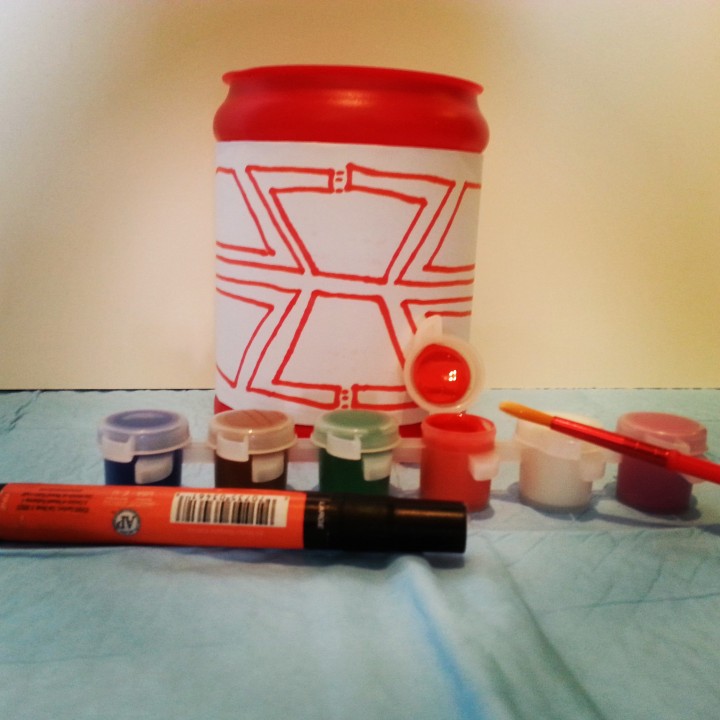
Our upcycled basket
We turned an old coffee container into a Tlingit-style basket with paint and bold lines. Grab a container and make your own!
It is fun and simple to make your own Kaleidoscope Art, aptly called Kaleidoscope Tiles! You’ll need: four paper squares, or tiles, a marker, and a ruler.
Tip: We used mini-canvas squares that we found at our local craft store.