Space


Elements of Design: Space
Plus: Positive and Negative Space
Space is an element of design that occurs around and in between the forms, shapes, colors and lines. It provides perspective, dimension and volume to a flat page. The techniques an artist uses to create space include:
By sizing objects according to their distance within the picture, the artist depicts depth. For example, in the painting below, artist Christian Landenberger paints his sailboats smaller and smaller to illustrate distance:
Try itOverlapping is another space-creating tool. An object that overlaps others is in the forefront while overlapped items appear to be farther away. In his “Still Life with Fan,” artist Georges Lemmen overlaps the fan with the flowers that are at the forefront of the space.
Try itComposition also helps create three-dimensional spaces. It relies on the vertical positioning of objects to suggest depth. Those items that are located at the bottom of the artwork are the closest to the viewer while items higher up on the page are farthest away. In the sailboats picture above, the sand is at the bottom of the painting while the clouds are at the top.
Try itLinear perspective tricks your eyes into seeing space within a flat surface. It is based the way you see parallel lines. For example, as train tracks extend into the distance, they appear to get closer together. In “A Turn in the Road,” Paul Cezanne’s parallel lines are the edges of the roadway.
Try itThe color and value of objects also affect space. In general, closer items are darker and warmer in color while faraway things are lighter and cooler. By combining several of these techniques, artists create distinctive, three-dimensional spaces that invite you to step into the scene and take a look around.
Try itScherenschnitte (“scissor cuts”) is a traditional German paper cutting craft. Different design techniques give the flat design dimension. In the paper cut pictured, the composition indicates dimension with the grass at the bottom and tree branches at the top. Also, people and animal forms overlap each other.
Try itCollage art mainly relies on overlapping of different shapes to create depth. In this collage, “ManRayMisunderstood,” the artist also uses color and value to show the nearness of different objects. Note how the dark building is the farthest away, and the brightly hued flower creature is closest.
Try itToday’s Art Idea for Kids: Bird Collage
To make a bird collage, you will need scissors, magazine pages, construction paper, a heavy background paper and glue.
No magazines handy? Build your bird collage on screen first with the next slide, then print it.
- Design a backdrop for your collage. You could draw it or paste magazine cuttings to the heavy paper.
- Cut several triangles, circles, ovals, squares and rectangles of different sizes from your magazine pages and construction paper.
- Experiment with laying them out in one or more bird designs on the background paper, overlapping shapes to suggest depth in the space. Size the birds differently to show perspective.
- Glue each piece onto the page.
Make your bird collage
What is Positive and Negative Space?
As an element of art, space includes the background, foreground and middle ground. It also refers to the areas around, between and within the forms, shapes, colors and lines that compose the work. Positive and negative space in arts and crafts can be tricky, or they can be (truly) black and white — they can assume the roles of foreground and background in a painting, or they can trade identities depending on your perspective. The concepts of positive and negative space are abstract and, in most cases, more difficult to identify than shape, color or size, so start with basic examples when presenting this concept the first time. Ultimately, by understanding the difference between positive and negative space, you gain important clues about the meaning of the artwork.
As Simple as Black and White
The easiest way to grasp the nature of positive and negative space is to look at a simple black and white graphic like the one below.
In this example, one of our students “painted” over a photograph to create a digital work that represents positive and negative space. Note that the subject (the people) would be the positive space, as they “pop” to the foreground, and the white areas are the negative space (the background).
Try itThis next one is a little “tricker” but also more fun:
Do you see the profiles of two people facing each other? If yes, then the black spaces are the positive images while the white area is the negative background. Conversely, if you see a white vase in the center of the picture, the black around it is the negative space.
Try itTessellation of Positive and Negative Space
Tessellation is a repeated pattern of geometric shapes that completely covers a surface without gaps or overlaps. Among the earliest examples of tessellation are wall decorations crafted by the Sumerians around 4000 B.C.
During the 20th century, graphic artist M.C. Escher created non-geometric, tessellated designs like “Regular Division of the Plane III,” below.
Try itMany colorful quilt patterns incorporate tessellated designs as well. Most of these are strictly geometric patterns consisting of squares, triangles, diamonds, rectangles and/or hexagons. For example, “Tumbling Blocks” features diamonds arranged to suggest three-dimensional squares. The intentional use of color in a quilt creates positive space – the primary pattern – and negative space – the secondary, background pattern. Often, the name of the quilt provides a clue to the positive image you should see.
The quilt maker’s choice of darker tones for the flowers in the “Grandmother’s Flower Garden” quilt block above contrasts with the lighter color of the hexagons that frame each flower. Thus, the darker pieces compose the positive space while the light ones compose the negative space.
Nōtan is Japanese for “light-dark harmony.” Make one below: each shape you cut from the dark square flips outside like a mirror. Not only is it a great art project on positive and negative space, it also helps artists develop an eye for scale, shape, and balance.
The Use of Space in Paintings
Determining the positive and negative spaces in a more complex, non-geometric work of art is typically a more difficult task because you must sift through additional nuances of meaning. Also, an object in the background, or negative space, may be just as important to the artist’s concept as the object occupying positive space.
Consider the following two artworks by 20th century artist Diego Rivera. The division between positive and negative space is quite clearly defined in the first example, “El Picador.” The figure of the man occupies positive space while the plain background comprises the negative space.
Positive and Negative Space Art Project
On a piece of graph paper, draw squares, triangles, rectangles, diamonds or a combination of these shapes that cover the area without leaving spaces or gaps, just like a tile-covered floor. Use colored pencils or markers to fill in the shapes, indicating a specific pattern of positive and negative space.
Hint: Use a quilt pattern as a guide. Experiment with positive and negative space by copying your pattern page several times before adding color and then varying your patterns to see different results.
You’re a space explorer!
Taking It Offline
These activities live on the screen, but art loves real paper, paint, and glue too. Here are things we made by hand, plus ideas to try at home.
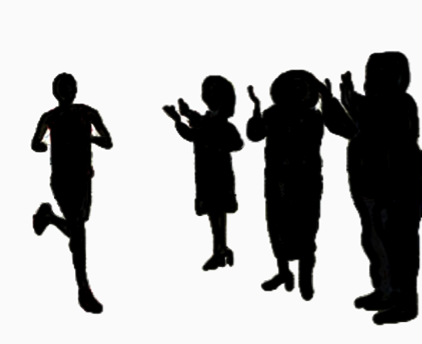
A real student project
In this example, one of our students “painted” over a photograph to create a digital work that represents positive and negative space.
Explore positive and negative spaceBird collage with real paper
To make a bird collage, you will need scissors, magazine pages, construction paper, a heavy background paper and glue.
See the stepsWant the whole story? Read the original posts: Elements of Design: Space and Positive and Negative Space