MathLibs.org™ – Free for Over 2 Decades!

Click for our newest, customizable snack-sized math question sets.

Classic Mathlibs™ is Back! (But it Does Require the RUFFLE Plugin)

Back in 2003, we coded the very first version of Mathlibs™. This was so well received by the public that we were overjoyed. Then, about 2 decades later, browsers ceased support for Adobe’s Flash® player, and MathLibs™ disappeared overnight. We are OVERJOYED to tell you that you can now access this remarkable content again by adding a browser extension called RUFFLE.

Please click here to add RUFFLE to you browser, and then enjoyed all of the wonderful content that has been serving children for over 2 decades — the interactive fourth grade math library, MathLibs™ question sets, rapid fire games! It’s all back!

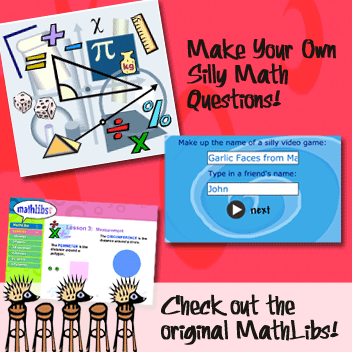
Make your own silly math questions! Have fun while reviewing 4th Grade Math for the state tests. (The click RUFFLE extension is required.) You can also view MathLibs™ FULL SCREEN (ad free) in a new window and try other fun math content below!

It’s easy to explore:

  • Click  MathLibs™ FULL SCREEN to choose between Multiplication MathLibs™ (Grade 3) and Grade 4 MathLibs™ sets. You can then generate your own silly math questions!
  • Click  MathLibs™ FULL SCREEN and then choose Lessons to click through fun animated Grade 4 math lessons in: Numbers, Patterns, Measurement, Geometry, Graphing, and Probability. If you prefer to hear audio with the lessons, click here. ← note this will be restored now that we know the power of RUFFLE, please check back!

math-libs-recommended-by-pbs-nctm

More Fun Math on KidCourses.com:

Note: these links are being be restored now that we know the power of RUFFLE. Please visit to links that say “working” after them. The other links will be restored in time. Please check back!

Colorful PDF of the Grade 4 Lesson 1 concepts (whole numbers, fractions, decimals, rounding, expanded notation, multiples, factors, what it means to be prime, the Associative and Commutative Properties, how we compare numbers and long division)

Rapid Fire Quiz, Lesson 1 (whole numbers, fractions, decimals, rounding, expanded notation, multiples, factors, what it means to be prime, the Associative and Commutative Properties, how we compare numbers and long division) working

Rapid Fire Quiz, Lesson 2 (using symbols instead of numbers, patterns, ratios, and percents) working

Rapid Fire Quiz, Lesson 3 (length, perimeter, area, volume, time, temperature, and estimation strategies) working

Rapid Fire Quiz, Lesson 4 (degrees, types of angles, parallel and perpendicular lines, shapes and solids, congruent figures, symmetry, and transformations) working

Rapid Fire Quiz, Lesson 5 (the coordinate grid, x-axis, y-axis, how to plot and find points, and how to use a grid to measure distances) working

Rapid Fire Quiz, Lesson 6 (charts, graphs, random sampling, probability, combinations, minimums, maximums, range, mean, median, and mode) working

5 Questions (with answer explanations) on Lesson 1, Numeration & Computation

5 Questions (with answer explanations) on Lesson 2, Patterns, Relationships, and Algebraic Thinking

5 Questions (with answer explanations) on Lesson 3, Measurement

5 Questions (with answer explanations) on Lesson 4, Geometry

5 Questions (with answer explanations) on Lesson 5, Coordinate Geometry

5 Questions (with answer explanations) on Lesson 6, Probability and Statistics

Try our Grade 4 Math Review with audio

In addition to playing our free Math Libs™, check out more fun math from kidCourses!

Click here for more fun math posts!


Non-Flash® Math Libs™

If you would like to see the (albeit inferior) non-Flash® content, we do have a few quickie question sets.

 Click to See Our Newest Mini Mathlibs™ Games


Mathlibs.org™ has been helping students have fun and get over their fears of math for almost a quarter of a century now! We’re working on adding more non-Flash Mathlibs™, and you can see the first, colorful and interactive ?question set here?.

We’ve also created some simple 5 question Choose Your Own Multiplication Tables Adventures. To try one, click here: https://kidcourses.com/official-math-libs/

Additionally, you can try HTML 5 MathLibs created in 2020 with Articulate. Click here to try!
Also:

If you have a PC, you can purchase the .exe version of Mathlibs™ for $9.99 here. You can also purchase simple PDFs of Mathlibs™ from our store.  It breaks my heart that Flash is gone. I hope to be able to load more free math games onto this site in the future. Please visit the shop for downloadable educational course materials in the field of mathematics for students from elementary through junior high, and downloadable printable material in the field of mathematics for grades 0-8. ~ Jessika Jake

Fear of Math is Real

Math research evokes a distinct kind of fear. This fear combines anxiety about performance, beliefs about fixed ability, and memories of past struggle. Studies consistently show that math anxiety lowers achievement, narrows course choices, and weakens confidence, even when students have the cognitive ability to succeed. The perception of being “bad at math” often arises from social messages and classroom experiences rather than innate limits. When this perception takes hold, it shapes identity and behavior, leading to avoidance and reinforcing the original fear.

Math anxiety grows in environments that emphasize speed, right answers, and public comparison. Students absorb myths such as “some people have a math mind and others do not,” “mathematicians do problems quickly in their heads,” and “there is a best way to do a math problem.” These myths encourage a fixed mindset and make every mistake feel like evidence of personal deficiency. Teacher anxiety and cultural stereotypes, including beliefs about who is “naturally” better at math, further amplify this effect. Over time, students may experience math as a source of threat rather than curiosity.

Research links this emotional response to measurable performance drops. Anxiety consumes working memory resources that students need for reasoning, problem solving, and conceptual understanding. Even when students know the material, anxiety during tests or multi-step tasks interferes with retrieval and flexible thinking. This mechanism explains why supportive interventions can raise performance without changing underlying intellectual ability. Reducing anxiety changes how students can use what they already know.

Games offer one of the strongest evidence-based approaches for reshaping these experiences. Studies on game-based and digital game-based mathematics learning show that well-designed games increase intrinsic motivation, persistence, and engagement. Games provide immediate feedback, repeated practice, and low-stakes failure, which gradually neutralizes fear responses. When learners play, they focus on goals, patterns, and strategies rather than on evaluation. This shift supports deeper conceptual learning and encourages experimentation.

Early childhood and elementary research finds that math games help children develop number sense, operations, and problem-solving skills while maintaining positive attitudes toward mathematics. Systematic reviews of math games in preschool through third grade show benefits for diverse learners when games are aligned with specific concepts and embedded in meaningful contexts. These findings support the design of playful, structured experiences that let children see mathematics as a field of patterns, stories, and decision making.

Digital game-based approaches extend these benefits into later grades. Interactive platforms that use visual guides, drag-and-drop activities, and exploratory tasks can lower anxiety in topics such as calculus and differentiation. Students report improved attitudes toward mathematics when they participate actively and receive immediate, informative feedback. These environments make space for trial and error without social penalty, which directly counters the performance pressure that feeds math anxiety.

Mathlibs.org™ fits this research-based need by turning math practice into a customizable storytelling game. The approach uses fun, free, and adaptable structures that invite learners to fill in mathematical elements inside narratives, puzzles, or challenges. The format allows teachers and parents to tailor content to specific skills, age levels, or classroom themes while maintaining a consistent, playful frame. This customization supports differentiated instruction and makes repetition feel like creativity rather than drill.

Classic Mathlibs (circa 2003+) on the Kidcourses site add a multimodal dimension. Visual representations reduce cognitive load and support learners who benefit from concrete or pictorial scaffolds. By linking images, numbers, and words inside a coherent game, Visual Mathlibs help students connect symbolic notation to intuitive ideas. This alignment matches recommendations from research on math myths and phobia, which highlight the need to connect abstract concepts with accessible experiences. Over time, such tools contribute to a broader cultural shift in how children encounter mathematics at home and in school.

The fear of math research points toward a clear educational priority: reduce anxiety, dismantle myths, and build positive, playful experiences with numbers and patterns. Game-based approaches, especially flexible and customizable ones, answer this need by giving learners a safe environment to explore, make mistakes, and discover that mathematical thinking is learnable. Mathlibs.org™ sexemplifies how long-standing, research-aligned tools can support this transformation for students, teachers, and families.

References

“Math Anxiety: Past Research, Promising Interventions, and a New Interpretation Framework” – Gerardo Ramirez, S. Shaw, Erin A. Maloney

“The Math Anxiety-Performance Link” – Alana Foley, Julianne Herts, Francesca Borgonovi, Sonia Guerriero, Susan Levine, Sian L. Beilock

“False Beliefs about Mathematics in Spanish Pre-Service Teachers and Relations with Math Anxiety” – M. É. N. Mateo, Francisco Manuel Morales Rodríguez, Ruiz Esteban, José M. García-Fernández, M. J., Santiago Pelegrina

“Math phobia and maths anxiety: multidisciplinary approaches for a more inclusive and equitable education in Brazil” – W. Ferreira, K. Richetto, Susana Aparecida Da Veiga, Maria Teresa de Moura Ribeiro, E. Gouvea

“The role of math games for children’s early math learning: A systematic review” – M. Depascale, Geetha B. Ramani

“Digital Game-Based Learning to Reduce Mathematics Anxiety” – Nor Kamariah Binti Kasmin@Bajuri, Muhammad Arif Amirun Bin Baharuddin, Ilyas Iskandar Bin Jumarin, Syed Muhammad Harith Bin Wan Ibrahim

“Development of a mathematics educational game to enhance students’ intrinsic motivation” – Jeewon Choi, Young Hoan Cho

“Interactive mathematics learning with educational game in junior high school” – N. Shalihah, Sutama, Adi Nurcahyo, Dwi Desmayanasari, Carla Maretha, M. Adnan

“GAME-BASED MATHEMATICS INTERVENTION FOR EARLY ELEMENTARY SCHOOL YEARS” – Alessandra Gotuza Seabra, Marcela Cristina Camargos dos Santos, Gabriela Eunju Ra, Grace Zauza Prado Amorim, N. Dias, L. R. Carreiro

“Investigating the Academic Performance of Math-Phobic Middle School Students” – M. C. Ekeh, Princewill Chinagorom Onuike

“Overcoming the Perception of ‘Bad at Math’” – Naneta M. Panit

“Pembelajaran Matematika Sekolah Dasar: Antara Kepercayaan Vs Realita” – Novy Trisnani

“The Myths of Mathematics That Never Fits To the Academics of Engineering Students” – Ch. Ramasanyasi Rao, Uma Kameswari, S. J. Prakash